

































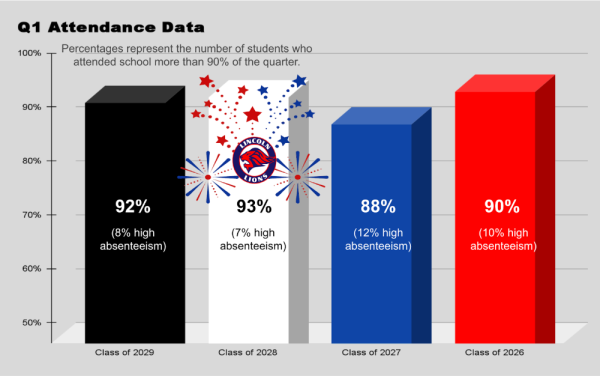
In this quarter’s battle for best attendance, sophomores finished on top. They led LHS in attendance with an impressive 93% of students being regularly present, which earned them this quarter’s Minute to Win It Challenge.
Freshmen were a close second with 92%. The seniors came in third with 90%, which is surprising considering that when they were juniors last year, they never dipped below 98%. The juniors came in last with 88%.
Assistant principal Nicole Lanni emphasized that attendance is a reflection of how motivated students are to succeed not just academically, but also in many other aspects of their lives.
“Attendance isn’t just about being present; it’s about giving yourself every opportunity to succeed,” she said. “Consistent attendance creates consistent progress.”
Fear of missing work and falling behind seems to be the main motivation for such a low level of absenteeism.
Sophomore Emily Benoit has only been absent three times this year so far; two of them were due to illness and the third because she missed the bus.
“I have to get my work done, and if I’m absent, I’ll get really far behind,” she said.
For most, missing a single day of school means spending up to a week to truly catch up to the rest of the class, especially for students who take more challenging classes.
Although juniors had the lowest percentage of students present, a good majority of them have large workloads, forcing them to understand the importance of being in the classroom.
“I know how much work I have and how important it is to actually do your work on time, so I’m careful about showing up to school and actually doing my work,” said junior Tanvi Bobbili.
It’s also important to understand why every day spent inside of the classroom counts. A 2018 study includes data showing that chronic absenteeism, defined as students who are absent for at least 10% of the school year, is associated with worse academic performance and lower graduation rates.
To put this into perspective, if a student is absent for 2 or more days each month, they are considered chronically absent. Such students have a graduation rate that is 18% lower than those who are more frequently present.
Each school day offers valuable opportunities for students to learn, and it is extremely difficult to take advantage of these opportunities without being physically present. Students who do not prioritize showing up to class face much more frequent problems with excessive missing assignments, making it exhausting to keep up with the pace of any class.
At LHS, no grade faced extremely high rates of absenteeism. It’s safe to say that the majority of Lincoln students understand that being absent is not only an inconvenience, but also has the ability to negatively impact their education in the long run.