



























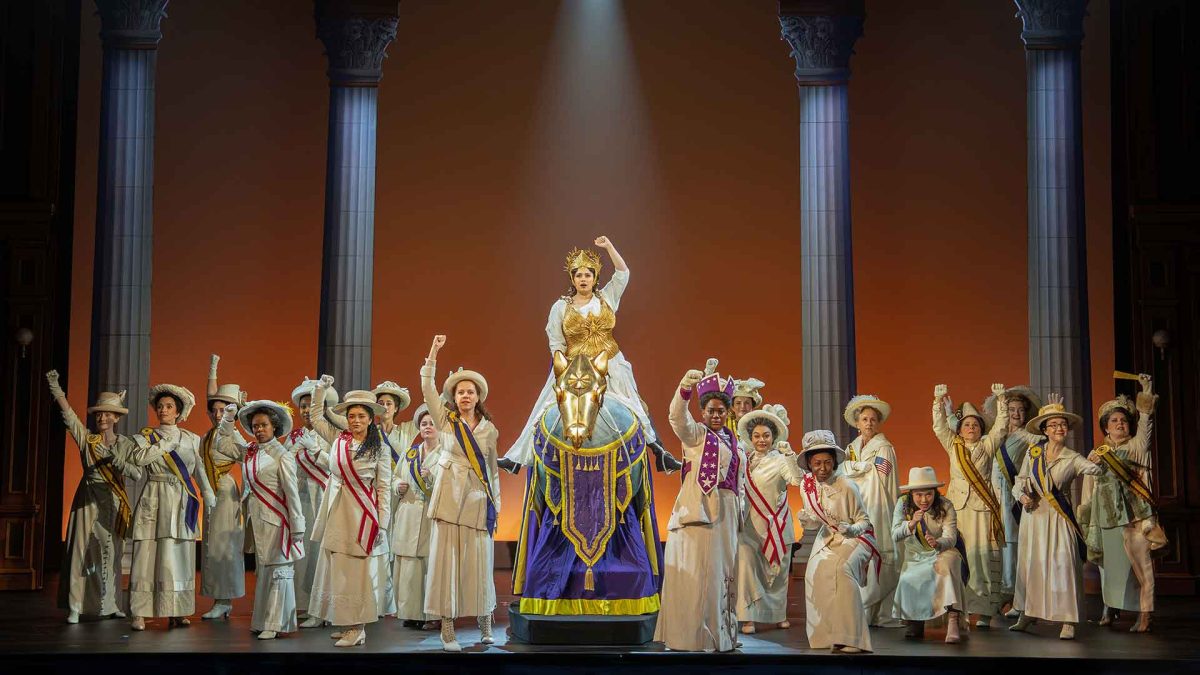
As someone who has seen many musicals, the Tony Award-winning musical Suffs is by far one of the best I have ever seen. I went to see the musical this past weekend at the Providence Performing Arts Center with three family members, and it is safe to say that we had the best time. The plot was captivating, and I found it especially interesting as a young woman. Watching such an amazing show, all about women, for women, was a feeling unlike any other.
Suffs follows the story of major women suffragists – also known as Suffs – who helped push for women’s rights and the ratification of the 19th Amendment from 1913 to 1920. Among these women were Alice Paul and her fellow members of the National Woman’s Party: Inez Millholland, Carrie Chapman Catt, and Doris Stevens. Alongside the suffragists were President Woodrow Wilson and his advisor Dudley Malone, the two male characters in the whole show. In the musical, both of these male characters are played by women.
This was a brilliant artistic choice made by Shaina Taub, the writer of Suffs. It was truly empowering to see a fully female cast – something that is not often done. The choice to cast women in traditionally male roles reinforces the musical’s central message: women and their voices matter, even in spaces where they have been excluded. This decision also highlighted the irony of women having to fight for the rights that men in power constantly delayed or questioned.
One of my favorite parts of the musical was the numerous nods to African American suffrage. As a young Black female, seeing such strong representation in a musical really spoke to me. Unfortunately, I feel that a lot of Black History is often ignored or at least overlooked, so I loved how this musical confronted it head-on and chose not to ignore the hardships African Americans faced as well. For instance, a predominant character in the story is journalist and civil rights activist Ida B. Wells. Her inclusion in this play was particularly important.
Ida and Alice had a complicated relationship. Ida believed in women’s suffrage, but more than anything, she did not want African Americans to have to wait to get their own inclusion and rights. Alice, on the other hand, only tried to tackle one battle at a time. I believe that this issue is still pertinent. Activism is split nowadays: some people believe that delaying justice for one specific group promotes inequality, while others believe that concentrating on one specific issue and/or group makes success more achievable.
Ida’s song in the play, “Wait My Turn,” is such a beautifully written piece. It is not only pertinent to the Civil Rights movement and the Suffrage movement, but to any movement in history. Throughout the song, Ida gives voice to the frustration of being asked to be patient while others are progressing. The lyrics capture the emotional toll of being told that her cause matters–but not yet. As the song says, wait my turn. Well, I sure don’t see you waiting for yours, no. You’re preaching, ‘We demand it now,’ while knocking down locked doors. But you want me to wait my turn”. What makes this song so impactful is how timeless it is. Today, marginalized groups are still being told to wait their turn until another issue is resolved. By using this song as Ida’s big moment, Suffs challenges the audience to question whether progress that excludes certain groups should really be called progress.
Overall, Suffs is an amazing musical and historical retelling of the woman who changed society in many ways. As I left the theater, I felt incredibly inspired and hopeful for the future. This show proves that when people are dedicated, progress is always possible.