

























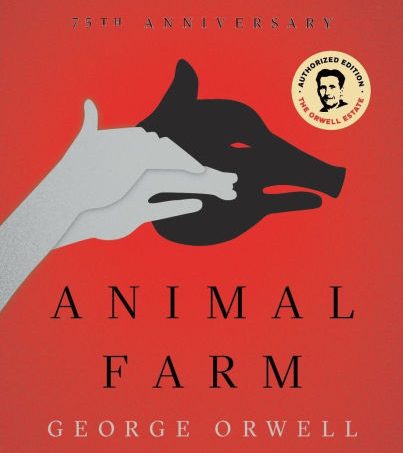
 Animal Farm, a 1945 allegorical novella about the Russian revolution by legendary dystopian fiction author George Orwell, remains relevant 80 years later. The book follows Manor Farm, owned by Mr. Jones and populated by talking animals, who revolt against Jones and take control of the farm. Renamed Animal Farm, the farm promotes equality for all animals and revenge on all humans, and is led by rival pigs, Napoleon and Snowball. Then, Napoleon gains total power and slowly establishes a dictatorship, resembling Jones more and more.
Animal Farm is both fast-paced and a short read, coming in at 144 pages, or three pleasantly disturbing hours in audiobook form. I actually recommend the audiobook because of actor Simon Callow’s chilling performance of the sheep’s rendition of Napoleon’s slogan, “four legs good, two legs ba-a-a-a-ad.” Despite the story’s dark atmosphere and even darker plot, it’s not too graphic for a squeamish vegetarian like myself. Yes, there are some sad moments of implied animal cruelty, but on-the-page violence is limited, and if I can handle it, you certainly can.
On a deeper level, Orwell’s novella is an allegory for the Russian revolution. An allegory is a story that uses everyday items to represent a more complex political conflict. In this case, the animals taking over the farm represent The Russian revolution, a 1917 rebellion against inequality in Tsar Nicholas II’s constitutional monarchy that gave power to the socialist Bolsheviks, who ended up exploiting the working class anyway. Jones represents Nicholas II, Napoleon represents Bolshevik leader Joseph Stalin, Snowball represents Stalin’s rival Leon Trotsky, and so on. Even neighboring farms represent neighboring countries. This is important history to recall, though not for the reasons Americans have often believed it to be.
Animal Farm has often been interpreted as anti-communist, most notably when the CIA secretly funded the 1954 film adaptation so they could use it as global anti-communist propaganda during the Cold War. However, readers of Animal Farm who interpret it to be against any specific country’s economic or political model are missing Orwell’s message: dictatorship could happen anywhere, at any time, under any ruler and any ideals. Orwell urges readers to remain independent thinkers, as the animals were not. What started as a positive revolution uses equity and loyalty to manipulate the animals and devolves into something terrible and exploitative. Yes, that happened in communist Russia, but in the digital age, world leaders openly lie in all kinds of political and economic systems. Animal Farm reminds readers to maintain a healthy skepticism of any authority, a message America and the greater world needs now more than ever.